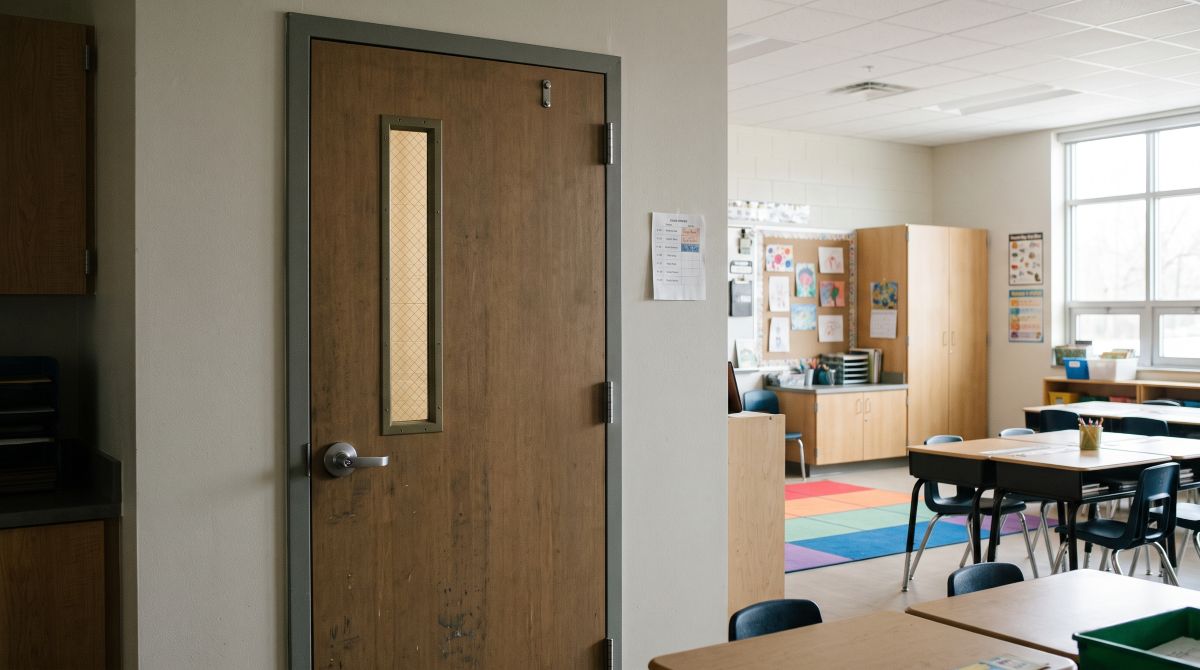
Retrofitting existing doors to add safety features is sometimes a quicker option than replacing the door itself (the door frame) or the entire entry system. Most safety enhancements concentrate on making the current door and its surrounding parts (like the frame and strike area) less vulnerable to damage, and increasing how well the door will function under extreme conditions. Most door failures occur in the most probable areas. Frames break apart due to applied force, strike plates loosen, glass breaks easily, and door hardware can be difficult to operate under the pressure of a life-threatening situation. However, fixing these problems can greatly enhance the protective capabilities of a door without the costs associated with constructing, disrupting, or replacing the original door. This is why retrofitting existing doors for safety is often a practical and efficient solution.
The most logical upgrades are typically uncomplicated. Increasing the strength of the frame and strike area, enhancing internal locking, reinforcing glass close to the door, and selecting hardware that is easy to operate in stressful situations all can have significant effects in improving the preparedness of a door, while keeping the original door intact. As all of these layers work in conjunction with each other, safety will feel like second nature. The door will continue to operate as it always has; however, it will be significantly stronger, much more reliable, and easier to quickly secure in times of urgency. In many settings, retrofitting existing doors for safety provides these benefits without major disruption.
Retrofitting means modifying the performance of a door system without having to replace the entire door. It focuses on the weakest areas of a door, and enhances how a door resists the forces that try to breach it. How a door holds, how it secures, and how it protects occupants in everyday situations and emergencies, is enhanced through retrofitting. In other words, retrofitting existing doors for safety improves performance while preserving the existing door system.
Typically, retrofitting begins with assessing and addressing the vulnerabilities of a door. While the majority of doors are made of solid materials, the areas around the door (frame, strike plate, hinges, etc.) are often far weaker than the door slab. Therefore, even if the lock is very strong, the door’s frame and/or the hardware securing the door can prevent the door from being safely secured. This is one of the main reasons retrofitting existing doors for safety should focus on the entire opening, not only the lock itself.
In addition to focusing on vulnerabilities, retrofitting also focuses on how occupants interact with the door in emergency situations. In non-emergency situations, a lock may seem adequate, but when the clock is ticking and occupants are experiencing elevated levels of stress, the lock may become more difficult to operate. Improving the visual appeal, ease of access, and intuitive operation of the door’s hardware can improve the likelihood that occupants will respond rapidly and accurately. Effective retrofitting of existing doors for safety should always consider how quickly and confidently people can use the hardware.
Retrofitting is a practical solution to enhance the protection of a door because it enhances the integrity of the door’s current functionality. Therefore, retrofitting can enhance protection without necessitating the installation of a new door, major construction, or extended periods of downtime. For many communities, retrofitting existing doors for safety is one of the most cost-effective ways to improve protection.
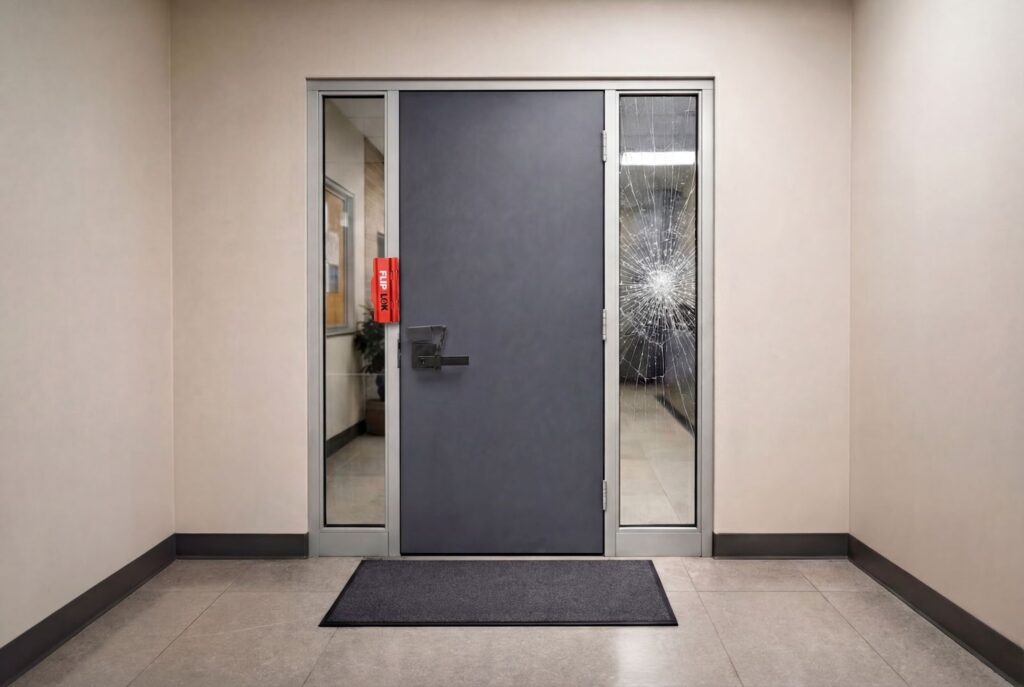
Which Door Upgrades Can Enhance Safety Without Complete Door Replacement?
The most effective retrofit upgrades generally focus on the door frame, strike area, and hardware. These are among the most frequent failure points, and the upgrades can produce a substantial increase in resistance and affordability. When retrofitting existing doors for safety, these areas are often the best place to begin.
Reinforcing the door frame and strike plate is often the most valuable retrofit upgrade. Utilizing longer screws, reinforced strike plates, and proper anchorage for the strike plate can prevent the frame from breaking and keep the latch area closed during heavy pressure. These upgrades are inexpensive, relatively quick to implement and do not alter the appearance of the door once completed.
Additionally, upgrading door hinges and fasteners can produce results, particularly in high usage areas. The operational success of a door is directly related to the successful operation of all components of the door system. Therefore, if one component of the door system is compromised, the entire door system can be compromised.
Another significant retrofit enhancement is interior locking. A door should be able to be securely locked from within the occupied space, without requiring the occupant to leave the space, find a key, or perform additional actions. Reliable mechanical solutions provide a basis for this requirement without relying on electricity or internet connectivity. This makes interior locking an important part of retrofitting existing doors for safety.
How Interior Locking Enhances Emergency Readiness
The ability to lock a door from within an occupied space is critical in emergency situations. Any locking mechanism that requires the occupant to vacate the space, locate a key, or perform multiple sequential motions, introduces hazardous delay.
Mechanical safety locks for doors provide consistent performance in both emergency and power outage situations. They rely upon no connectivity and work similarly every time. This consistency reduces uncertainty and promotes faster responses in high-stress situations. For this reason, interior locking remains a central part of retrofitting existing doors for safety.
Interior locking is not solely concerned with speed. It also assists in reducing exposure. An occupant should not be required to open a door to lock it in an environment of unknowns. A properly designed locking mechanism provides rapid response capability while allowing the occupant to focus on their safety.
Therefore, if the primary purpose of the retrofit is to enhance emergency readiness, then interior locking should be a primary area of assessment. It increases the effectiveness of both daily use and emergency responses without the necessity of total door replacement. In many cases, retrofitting existing doors for safety begins with improving interior locking.
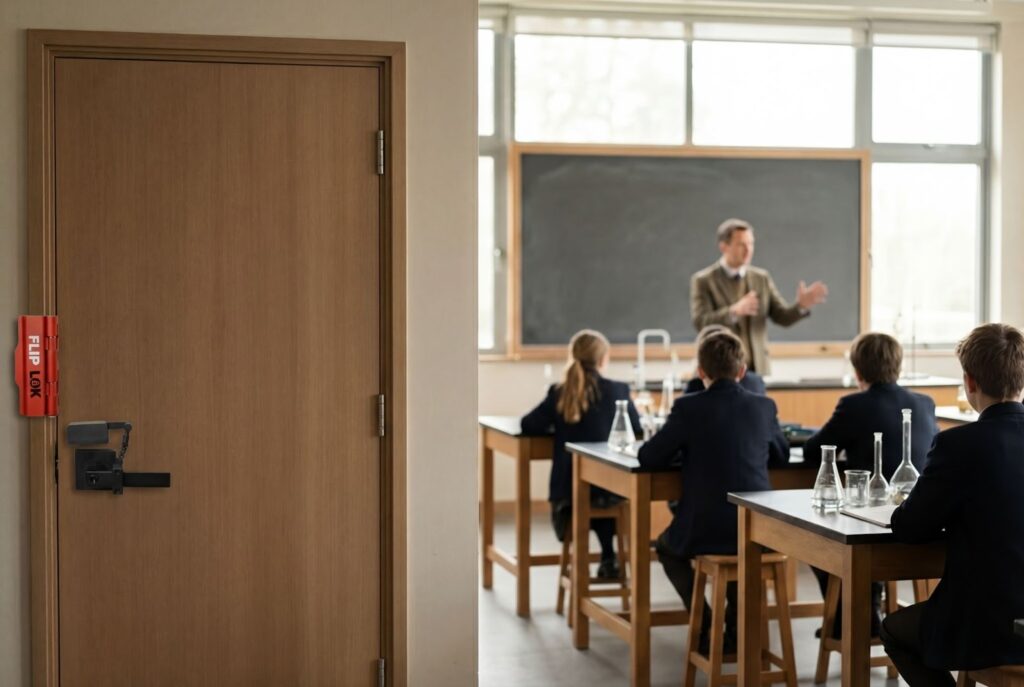
Why Glass Reinforcement is a Critical Retrofit Element
Glass adjacent to doors is frequently overlooked, but it can represent a critical weakness. Sidelights and adjacent windows next to doors may provide unauthorized access even when the door is locked. In many instances, the door remains intact, but the glass is broken.
Security window film assists in holding glass fragments together after impact, thereby slowing intruder progress and reducing injury potential from shattering glass. This retrofit retains the existing glass in place while providing an additional layer of resistance. Additionally, it enhances safety by minimizing the amount of glass that shatters. As part of retrofitting existing doors for safety, glass reinforcement helps address weak points that might otherwise be ignored.
Glass reinforcement is particularly beneficial in situations where replacing glass would be costly or impractical. It may be installed without removing the door assembly and can assist in protecting those weak points that are commonly neglected in basic door upgrades.
A comprehensive retrofit strategy includes the evaluation of the entire entry area, including the door, frame, and glass. When the door, frame, and glass work together effectively, retrofitting existing doors for safety can produce a more dependable barrier.
How Accessibility Relates to Door Safety Retrofits
Safety provided by door mechanisms should not require physical strength, precision, or extraordinary reach. Accessibility is critical in both daily operation and emergency response scenarios when stress impairs fine motor control and coordination.
When retrofitting, the door hardware selected should be capable of being seen, reached, and operated by individuals of varying height and mobility. Compliance with ADA standards and intuitive design principles enable safety equipment to be utilized with greater confidence and accuracy, regardless of the level of stress experienced. Accessibility should always be considered when retrofitting existing doors for safety.
Additionally, accessibility enables training. With simpler and repetitive operating characteristics, more individuals can utilize the device effectively. Reduced confusion, increased confidence, and enhanced overall readiness are the result of utilizing devices that are easier to understand.
The most successful retrofit strategies combine increased protection with improved usability. When safety upgrades are more accessible and easier to understand, the likelihood of using them correctly and consistently is higher. Overall, retrofitting existing doors for safety is most effective when protection and usability work together.