School safety improvements begin with identifying the most critical vulnerabilities and strengthening the highest-value aspects of your campus protection. The first key for creating the safest possible environment for your students isn’t a new product or technology. Instead, it’s identifying the most critical vulnerabilities and improving the highest-value aspects of your school’s safety. For schools and districts, effective school safety improvements are based on reliability, ease-of-use, and providing practical protection for teachers under extreme stress.
There are numerous ways for safety discussions to drift off course into large-scale systems, expensive upgrades, or lengthy wish lists. Budgetary constraints, lack of time for training, and maintenance costs can severely limit the feasibility of such projects within the confines of a campus community. Therefore, focusing on a few high-impact, achievable goals will generally yield the greatest results.
Many school districts in the Houston area and throughout Texas have had to balance preparedness for emergencies with the realities of budget and available time for staff training. The objective of safety planning is not to achieve absolute perfection. Rather, schools must create dependable protection that their staff can dependably use under all circumstances.
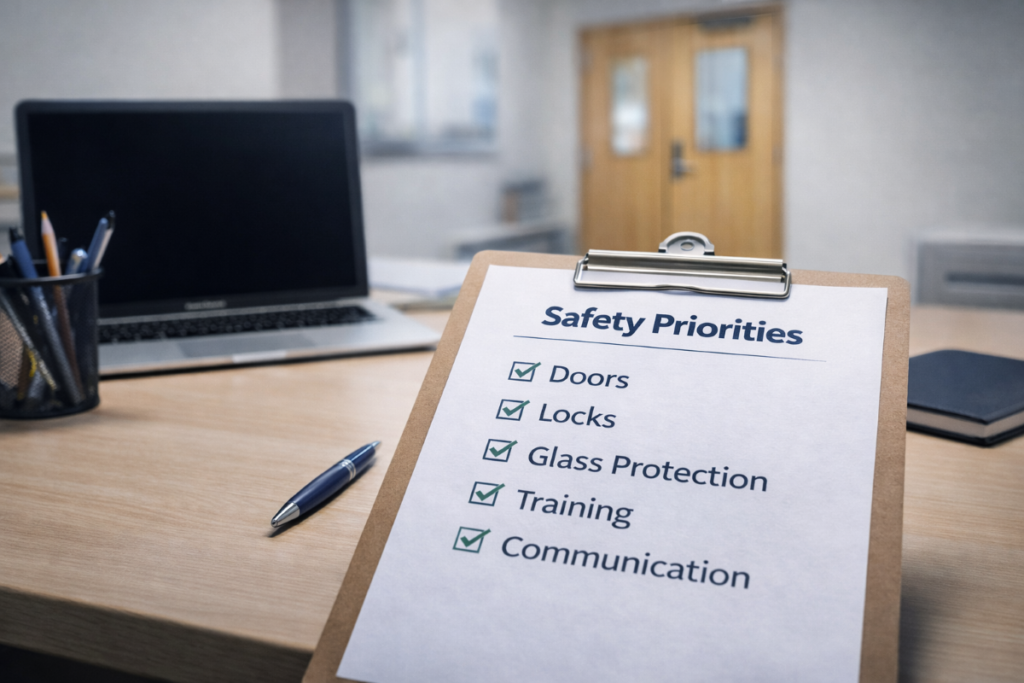
By identifying the most critical vulnerabilities, such as the classroom door, and strengthening weak points, such as glass, and by providing training on simple procedures, schools can establish a safer and more dependable environment through practical school safety improvements.
Secure The Classroom Door From Inside The Room
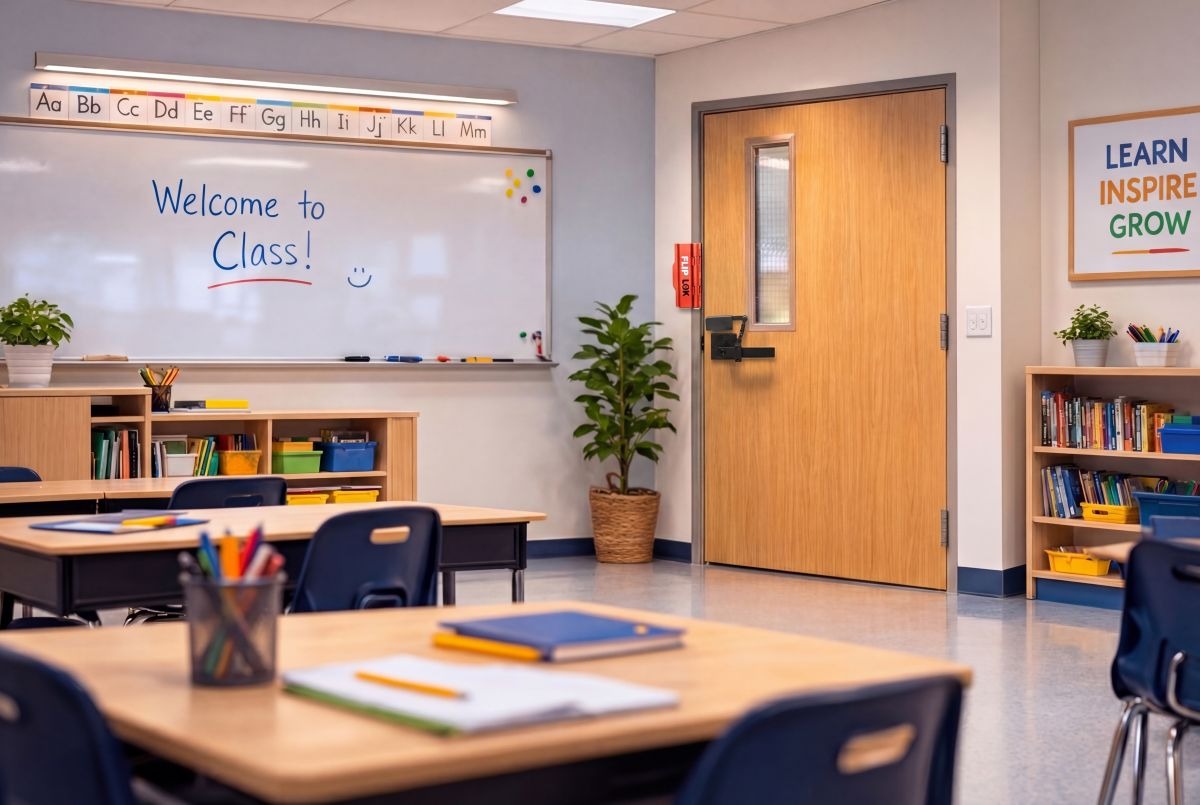
If there were only one area in which a school could upgrade its safety features, it would be the ability to secure the classroom door from inside the classroom. A teacher should be able to lock the classroom from inside the classroom quickly, in seconds, without having to leave the room, and without needing to rely upon some type of electronic or remote system. This is referred to as “interior locking.” This type of locking allows teachers to secure the classroom and protect the children in their care, while at the same time reducing the amount of time spent outside the classroom.
One reason why interior locking is so critical is that it eliminates unnecessary actions. When the locking mechanism is quick and consistent, teachers can rapidly secure the room and begin focusing on the needs of the children in their care.
Another significant advantage of interior locking is that it can be implemented relatively inexpensively. The most common method for securing the door from inside is to modify existing door locking mechanisms. In many cases, there is no need for a complete door replacement. Existing hardware is upgraded to provide a simple and repeatable means of securing the door from inside. This makes interior locking one of the most practical school safety improvements for many districts.
If you are currently considering the types of classroom door safety measures to implement in your district, you may find useful planning materials in the CISA K–12 School Security Guide.
Reinforce the Door, Frame, Hinges, Strike Plate and Hardware
Locking a door is just one aspect of protecting the classroom. All parts of the door, including the door itself, the frame, hinges, strike plate and hardware, must work together to create a secure door. If the door resists being opened after it has been locked, it will provide a reasonable level of delay, thereby providing time to react and possibly prevent harm.
While replacing large portions of the door system may be costly, it is often possible for a district to reinforce the weaker components, such as the strike plate, to make the entire system stronger without breaking the bank. Improved hardware and additional frame support can greatly enhance the overall strength of the door system while remaining economically viable.
Reliability is often far more important than features. In a crisis situation, teachers want to know that they can rely on tools that will behave consistently. Tools that are dependent on power and connectivity may fail under stressful conditions. Tools that are mechanically driven tend to be more reliable and less prone to failure due to electrical or networking issues.
Mechanical-based systems offer additional benefits. Since they do not rely on connectivity, schools can ensure that their tools will function regardless of the status of the campus’ electrical grid or telecommunications infrastructure. By focusing on developing tools that can be relied upon, regardless of external factors, schools can greatly reduce the potential for equipment failure and minimize the number of variables to consider when developing training programs. These types of school safety improvements can also support long-term reliability.
Protect Glass Vulnerabilities Using Reasonable Solutions
Glass is another common vulnerability that is often overlooked in initial planning efforts. Vision panels and sidelights can provide a pathway of attack even when a door is securely locked. Therefore, addressing glass vulnerabilities can result in a high-impact improvement.
One affordable option to address glass vulnerabilities is the application of security window film. Window film can help hold the glass together after an attack, potentially slowing access and minimizing injuries caused by broken glass. Unlike replacing doors or windows, applying security window film is typically less invasive and can be done in strategic locations that present a higher priority.
Using practical solutions, such as security window film, to address glass vulnerabilities, can help schools develop a more comprehensive strategy for managing vulnerabilities. In addition to providing physical security tools and strategies, SchoolSafety.gov offers a variety of other resources to assist schools in developing a layered approach to managing risks.
When schools identify and address both the door and surrounding glass vulnerabilities, they can significantly reduce the number of bypass points and develop a more dependable barrier. For many districts, this is one of the most cost-effective school safety improvements available.
Select Tools That Support Sustainability, Simplify Training, and Minimize Maintenance
All safety solutions have the potential to fail. However, the likelihood of failure can be minimized by selecting tools that are simpler to use. Complex tools require extensive training, are more difficult to maintain, and are more susceptible to failure. Tools that require frequent software updates, battery replacements, or technical troubleshooting can become unsustainable over time.
Tools that are easier to use provide a greater margin for error. Because teachers will be operating under stress in an emergency situation, their ability to respond correctly will be reduced. A single, consistent step is more reliable than a series of steps. Under stress, fine motor skills and memory are compromised. Clear one-step actions are more reliable than multi-step processes.
Advantages of Selecting Less Complex Safety Solutions
Simpler safety solutions:
Reduce staff response times
Require less training time
Have lower maintenance costs
Have fewer failure points
When selecting safety tools, consider how the tools will function in the event of a power outage, network disruption, or when used by substitute staff who may have limited training time. Less complex tools provide a greater margin for error and support sustainability. These are important considerations when planning lasting school safety improvements.
Build Trust Through Drills, Feedback, and Communication
The final element of effective safety planning is ensuring that the selected tools and procedures are well-understood and effectively utilized. Districts should evaluate how quickly classrooms can be secured, whether staff members feel confident in using the provided tools, and how consistently procedures are executed.
Building accountability does not have to be punitive. Instead, it can be accomplished through feedback loops, regular communication, and brief refresher courses to keep procedures top of mind. Parents and families will appreciate transparency regarding safety improvements. Open communication fosters trust and reduces misinformation.
FAQ
SCHOOLS – What Are Some Of The Best Initial Safety Improvements To Make?
Classroom door locks and other interior locks are generally the best first step to improving safety in many schools. Classroom door locks allow a teacher to secure the classroom without having to enter the hallway. While there are many types of features and improvements that can enhance a school’s safety, the best improvements tend to be those that are low-maintenance, easy to understand and reliable. Look to web sites such as CISA and SchoolSafety.gov to find guidance on layering your school safety plans and making your school safety improvements realistic.
DO ELECTRONIC ACCESS CONTROL SYSTEMS NEED TO BE USED IN ORDER FOR A SCHOOL TO HAVE EFFECTIVE SAFETY?
Not necessarily. Access control can provide management and tracking functions, but also introduces the need for power, connectivity, and continuous maintenance. Many schools give priority to mechanical solutions for securing classrooms because they will continue to function well even in the event of an electrical outage or loss of internet connection. In most cases, electronic solutions are used to supplement a school’s safety measures rather than being the only method of safety.
IS IT WORTH THE COST OF PROTECTING GLASS?
Yes. Protecting glass in schools, particularly near doors with side lights, provides a clear means of stopping a potential intruder. Even if a door is secured, a determined person could potentially break through the glass. There are practical options available for protecting glass such as security window films. These products can help prevent shattering of the glass upon impact and slow down the potential intruder. Like many school safety improvements, districts can protect glass strategically in areas where the threat level is higher.
HOW CAN DISTRICTS REDUCE THEIR LONG-TERM COSTS?
When purchasing safety equipment and systems look for solutions that require less maintenance and fewer updates. Solutions that have a high number of components that need to be replaced or troubleshooted can add up in cost. Solutions that have fewer moving parts and are simple to understand and use will be easier for district employees to train on and use properly. As you make safety improvements to your buildings, when employees know what to do and can do it correctly every time, then safety becomes much more sustainable.
HOW DOES FLIPLOK SUPPORT HIGH IMPACT SOLUTIONS?
Fliplok was developed to support fast, reliable interior classroom locking with just one action and no power or connectivity required. Fliplok is ADA-compliant and designed to resist more than 2000 pounds of force. By supporting the top three priorities, reliable protection, simple operation and strong physical resistance that enables teachers to respond quickly during an emergency situation, Fliplok is a great fit for your school safety program.
Prioritizing School Safety Improvements That Matter Most
Effective safety planning involves identifying and implementing improvements that work reliably under real emergency conditions. When a school identifies classroom doors, strengthens their door systems, addresses potential weaknesses in glass, and trains its staff to respond to emergencies using simple procedures, it creates a safer environment that is easier to maintain and rely on.
FlipLok supports these priorities with one motion interior locking and dependable performance without power or connectivity. Additionally, Fliplok has been physically tested to withstand more than 2000 pounds of force. Fliplk was created specifically to meet the needs of classroom security. If you would like to learn more about our school safety solution, contact us today.